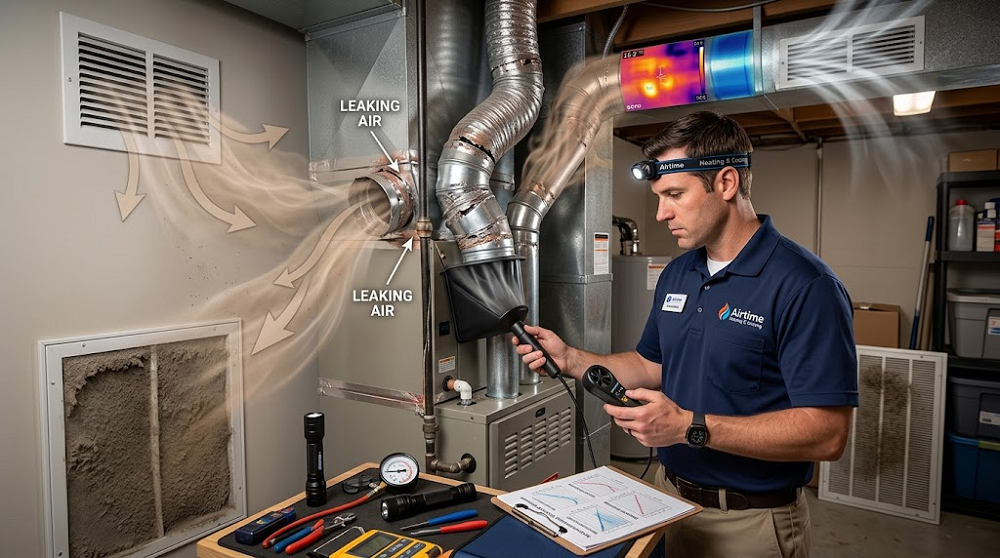
Uneven room temperatures, weak vent discharge, and strange noises usually indicate underlying heating airflow problems. When your furnace cannot circulate air properly, your home struggles to maintain a consistent temperature, leading to higher energy bills and extra strain on your equipment. Identifying these issues early helps prevent complete system failures and keeps your living space comfortable throughout the colder months.
Homeowners in Riverton, Herriman, Draper, Bluffdale, and Lehi depend on reliable indoor heating when winter temperatures drop. Airtime Heating & Cooling provides expert HVAC maintenance and repair services to keep your system running smoothly. If your current unit is old or beyond repair, our team can help you determine if a repair or a heater replacement is the best long-term solution for your home.
Understanding how air flows through your heating system empowers you to spot minor issues before they become major repairs. Here is what this guide covers:
When one bedroom feels freezing while the living room stays warm, your furnace is likely struggling with circulation. Uneven temperatures happen when warm air cannot reach every supply register equally. This imbalance forces your system to run longer cycles to satisfy the thermostat setting.
Restricted air distribution causes warm air to trap inside the furnace cabinet instead of circulating through your living spaces. Over time, this buildup causes internal temperatures to spike, triggering safety switches that shut down your heating cycle prematurely. Addressing airflow early prevents this repetitive short-cycling and keeps every room comfortable.
Clogged filters are the single most common cause of heating airflow problems. As dust and pet dander accumulate on the filter screen, the blower fan works harder to pull air through. Replacing disposable filters every one to three months ensures smooth, unrestricted circulation.
Supply registers and return grilles also need regular inspection. Closing vents in unused rooms creates static pressure inside your duct network, which disrupts overall system balance. Make sure all registers remain open and free of blockage from furniture, drapes, or rugs.
| Component | Common Problem | Simple Solution |
| Air Filter | Dust accumulation and debris buildup | Replace every 30 to 90 days |
| Supply Vents | Closed louvers or furniture obstruction | Unblock vents and open louvers fully |
| Return Grilles | Dust layer blocking intake opening | Vacuum grilles clean regularly |
Ductwork connections can separate or crack over time, especially in unconditioned attics or crawlspaces. When warm air escapes through small gaps in your duct joints, less conditioned air reaches your living spaces. Duct leaks also pull cold air, dust, and insulation fibers back into your airflow stream.
Blower motor failure presents another major obstacle to air circulation. A worn motor belt, faulty capacitor, or dirty fan wheel reduces fan speed significantly. If you notice faint buzzing sounds or very weak air blowing from registers, your blower assembly needs professional attention.
Keeping digital records of your repair history and monthly heating bills helps you track performance over time. Sudden spikes in utility costs often indicate your furnace is consuming extra energy to overcome restricted airflow. Save digital receipts, filter replacement dates, and technician notes in a central online folder or home management app.
Tracking expenses digitally makes it easy to compare rising repair bills against the cost of new equipment. When maintenance frequency increases rapidly, reviewing your digital paper trail helps you decide when to stop patching an old unit and invest in updated equipment.
Common warning signs include weak air coming from vents, uneven room temperatures, whistling noises near grilles, and a furnace that turns off quickly after starting.
Yes, a clogged filter blocks airflow, causing the heat exchanger to overheat. This triggers the safety limit switch, which turns off the burner to prevent damage.
Yes, you should keep all supply vents open. Closing vents increases pressure within ductwork, which damages blower components and reduces system efficiency.
Schedule a professional furnace tune-up once every year, ideally during autumn before heavy winter use begins.
Identifying heating airflow problems quickly saves energy and preserves the life of your furnace. Simple tasks like changing filters and opening vents help maintain proper air movement across your home. For deeper issues like duct leaks or blower motor wear, professional diagnostics ensure your equipment operates safely and efficiently.
Airtime Heating & Cooling delivers dependable heating solutions across Riverton, Herriman, Draper, Bluffdale, and Lehi, Utah. Our qualified technicians perform complete system evaluations to restore balanced airflow and consistent warmth. Contact Airtime Heating & Cooling today to schedule your annual heating maintenance or diagnostic inspection.